Belfast is back in the whiskey business
Belfast once produced around three quarters of Ireland’s whiskey before its distilleries disappeared altogether. Almost 90 years later, the stills are running again, old names are returning and a new generation is finding out whether the city can become a whiskey powerhouse once more, writes Tom Pattinson
Paul Kane has a habit of making a night out slightly harder to predict than it should be. Over several days at Belfast Whiskey Week this summer, the Scottish-born organiser seemed determined that nobody should have an empty glass and no one should get near a bill. He is an entrepreneur with an impressively varied collection of businesses and an equally varied orbit of people around him. On my evenings out with him I met characters including a former soldier, a Brazilian footballer, a boxer, bar owners galore and a gaggle of musicians. Kane is kind, gregarious and generous, with the restless energy of someone eager to seek out and befriend the few people he doesn’t already know in the city.
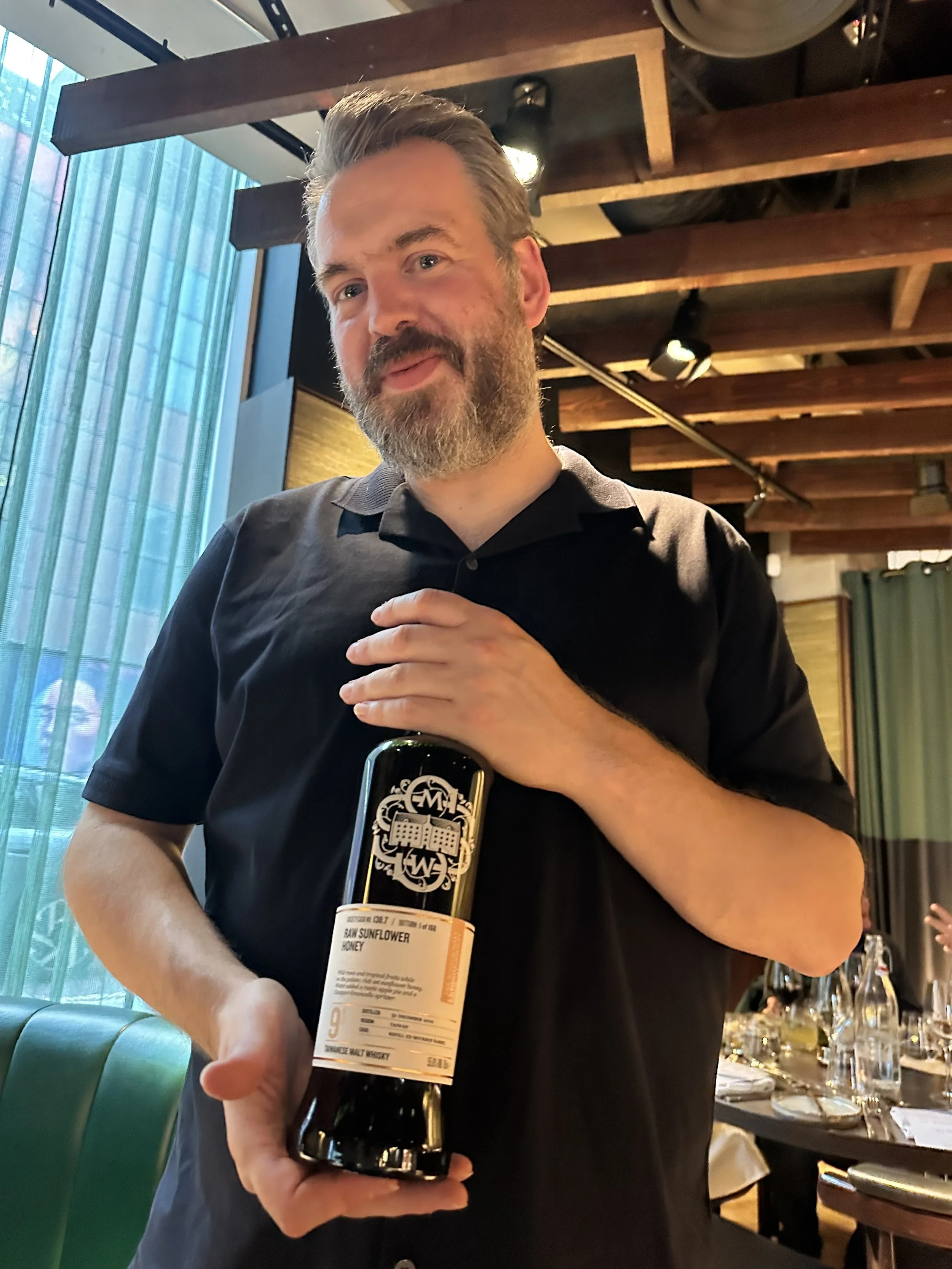
Paul Kane founder of the Belfast Whiskey Week
Whiskey came into his life after discovering an old bottle that had belonged to his grandfather, leading him into discontinued releases and collectable whisky. Kane became adept at buying bottles he thought were undervalued and selling some later for considerably more, until the collector became more interested in drinking the stuff than trading it. At one stage, he says, he opened something approaching 400 bottles simply because he wanted to understand how whisky from different distilleries and countries actually tasted.
That journey led to Belfast Whiskey Club and then Belfast Whiskey Week, which this summer stretched across nine days and more than 100 events under the suitably Belfast slogan: “It’s not just ya Da’s drink anymore.”
“This city was built on whiskey,” Kane tells me over a typically heart punishing Irish breakfast.
You could be forgiven for not knowing it. Belfast has turned Titanic into one of its defining stories, while linen, rope-making and shipbuilding remain an obvious part of its industrial history, but whiskey has largely vanished from the collective memory despite once operating on an extraordinary scale. In 1901 Belfast produced an estimated 6.7m gallons, around 30m litres, equivalent to roughly 75 per cent of Irish whiskey output.
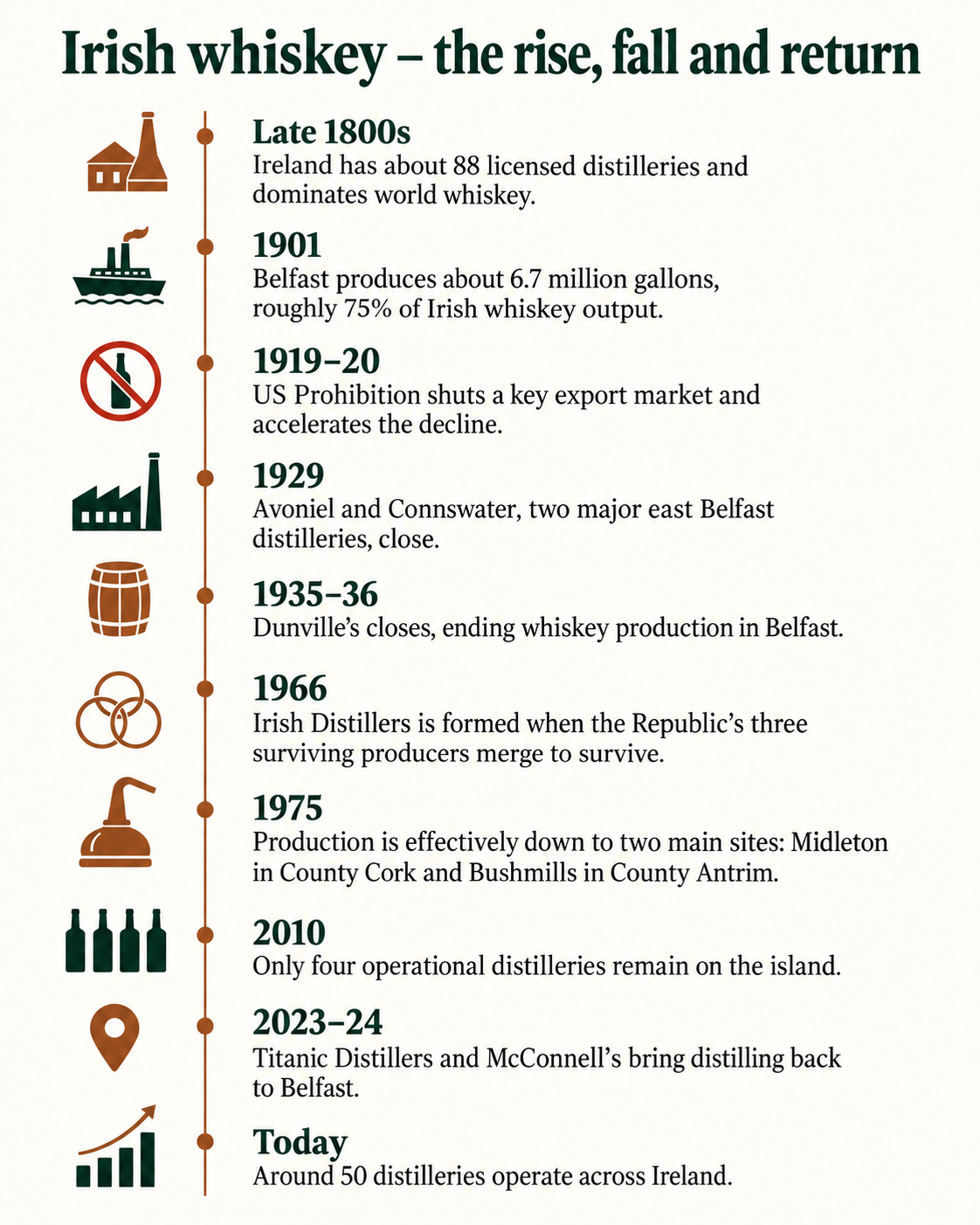
America was central to that trade, until a succession of wars, political upheaval and shrinking markets began pulling the industry apart. The First World War disrupted exports, Irish independence changed established trading relationships and Scottish producers were quicker to exploit column stills and blended whisky. Then Prohibition took effect in the US in 1920, abruptly closing one of Irish whiskey’s most valuable markets. As much as 50 per cent of the worldwide whiskey market disappeared, while bootleggers compounded the damage by selling rough illicit spirit under Irish names.
Belfast’s great distilleries then fell with startling speed. Avoniel, an east Belfast grain distillery opened in 1882 and built around large Coffey stills, and the much larger Connswater Distillery, opened nearby in 1886, both stopped production in 1929 following Prohibition. Dunville survived into the 1930s before its vast west Belfast operation also closed, leaving a city that had dominated Irish whiskey production without a working distillery.
The contraction continued across the island until by the mid-1970s production had effectively retreated to two sites: the new Midleton Distillery in County Cork in the south and Bushmills in County Antrim in the north. Belfast would have to wait considerably longer for whiskey to return.
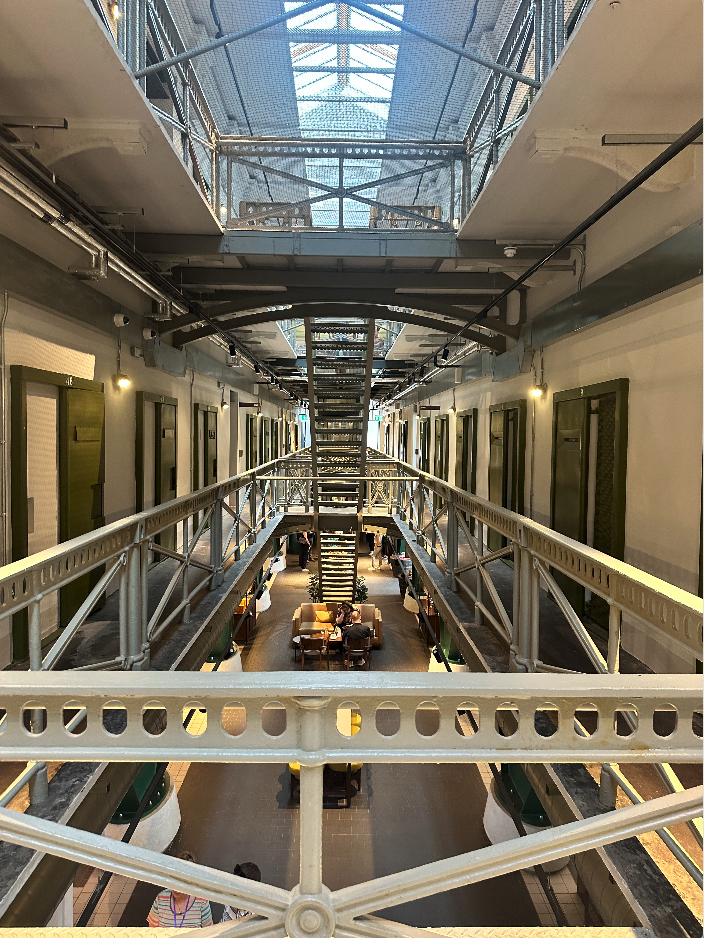
McConnell’s distillery in Crumlin Road Gaol
McConnell’s had been a Belfast name since 1776, beginning as a whisky merchant and bonder before John and James McConnell opened the Cromac Distillery beside the River Lagan in 1899. It became one of the city’s major export whiskies, particularly to America, before the distillery closed during the collapse of Irish whiskey in the 1930s.
The name reappeared as a brand in 2020, construction of its new Belfast distillery began in 2022 and production finally started in 2024 inside A-wing of Crumlin Road Gaol. The Victorian prison opened in 1845 and remained in use until 1996, later holding both republican and loyalist prisoners during the Troubles.
It is an extraordinary place to make whiskey, with long iron galleries and old cells retaining the unmistakable atmosphere of a prison while huge copper stills rise through the restored wing. Installing them involved opening the roof of the Grade A-listed building and lowering the 5,000-litre wash still and two 3,000-litre spirit stills into position by crane. The effect is hugely impressive but spooky. I wouldn’t want to be the one closing up at night.
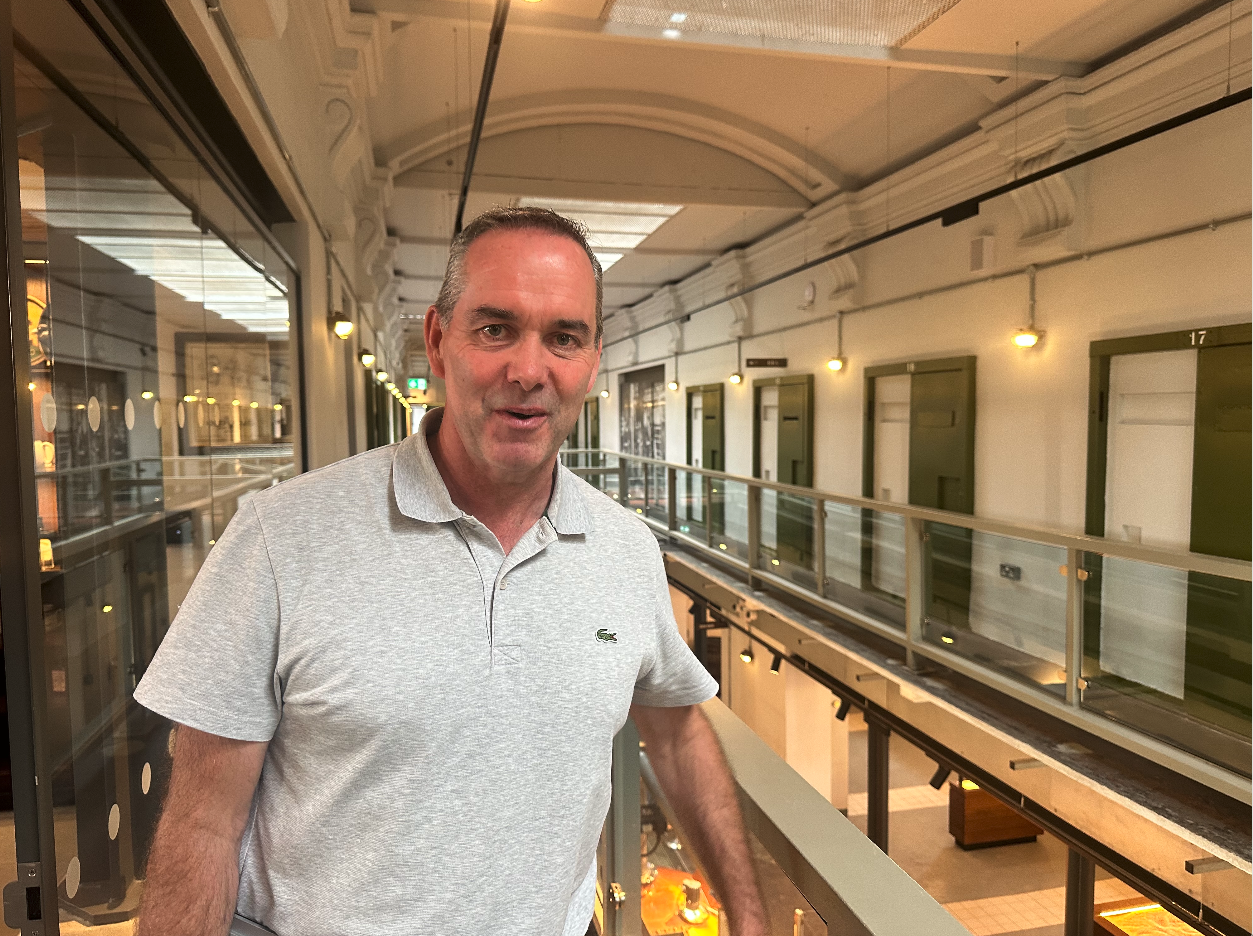
John Kelly, chief executive of McConnell’s
The man who does regularly lock up here is John Kelly, chief executive of Belfast Distillery Company. He grew up in north Belfast and went to school just over the prison wall. After more than two decades with Diageo, including several years in Dubai, followed by four years with Walsh Whiskey, he returned home to join the project.
“This business has brought regeneration to my own backyard,” he told me, describing the attraction of being able to “put your stamp on your own city”.
For now, the McConnell’s distilled here and the McConnell’s in its mature bottles are different things. Its core five-year-old is a 60:40 blend of grain and malt whiskey matured in first-fill bourbon barrels, while sherry and cognac finishes build on the same base.
“We’re five years old. Our distillery is only two years old,” Kelly says. “Very clear we are blenders.”
The standard five-year-old is light and easy, but the sherry finish was significantly better for me, bringing darker fruit, Christmas cake and chocolate while retaining the sweetness of the bourbon maturation. The 20-year-old Old Cromac Collection was stronger again, with considerably more concentration, spice and depth, showing what McConnell’s can do with the older stocks it acquired while waiting for its own Belfast spirit to mature.
But what really stood out was their new make spirit. If what goes into the barrel is no good then its a lot harder to make great whisky, but McConnell’s new make was exceptional. Unusually approachable, already showing apples, blueberries and raspberries before the cask has had much chance to intervene. McConnell’s therefore has whiskey in bottles now, new Belfast spirit ageing for later and one of the most remarkable distillery settings in Ireland connecting the two.
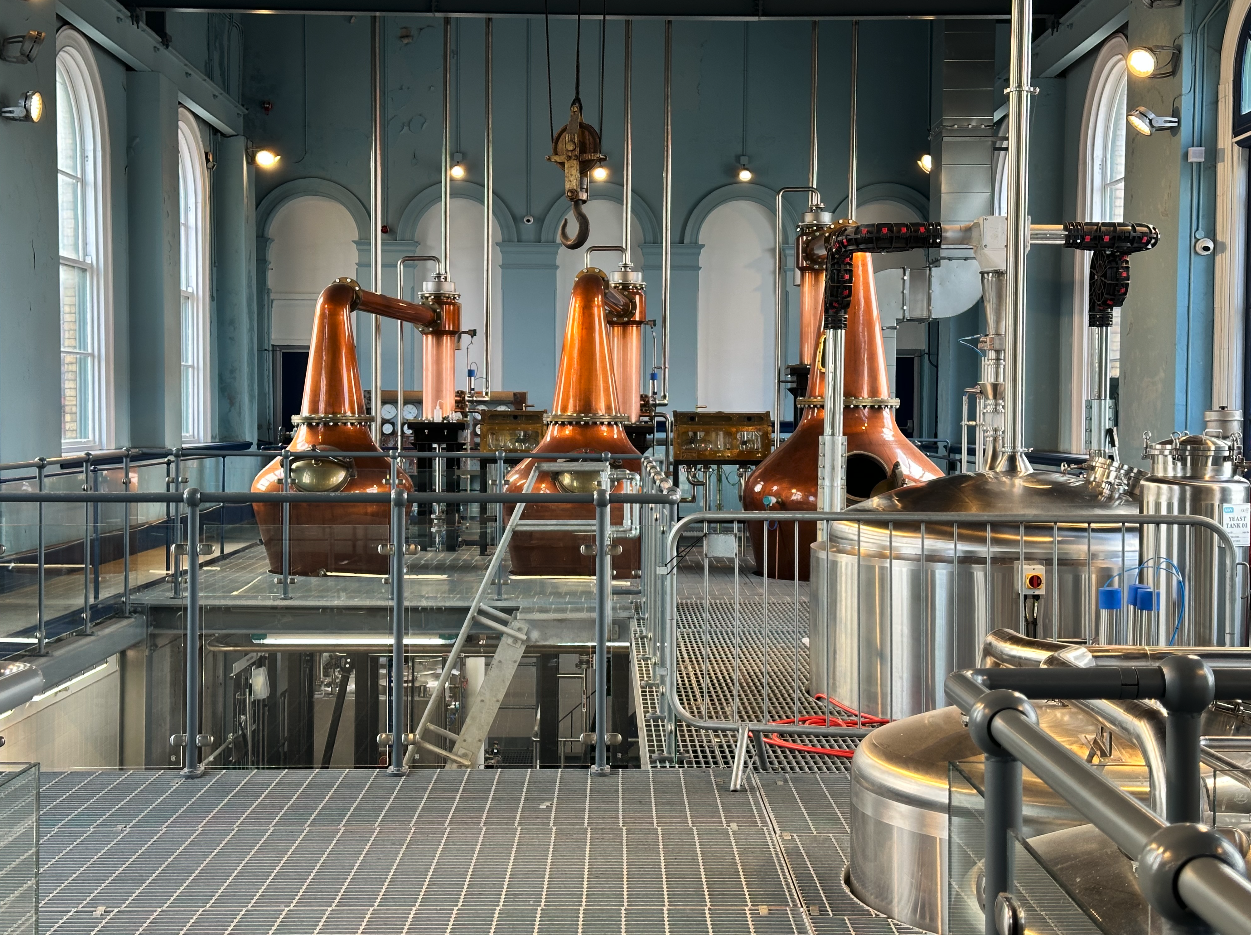
The three stills at Titanic Distillers
Across the city, Titanic Distillers beat it to the first drop of new Belfast spirit, beginning production in August 2023 inside the Thompson Dock pumphouse and ending an 88-year absence of whiskey distilling in the city. From the windows you look straight into the vast dry dock where Titanic was fitted out before leaving Belfast.
Its founder, Peter Lavery, has an equally unlikely Belfast story. A bus driver before winning £10.2m on the National Lottery in 1996, he subsequently built a business career and moved into whiskey before helping bring distilling back to the docks.
When Barley visited previously, chief executive Stephen Symington was keen that the building should not overpower what was happening inside it. “Outside of the site’s massive tourism appeal and historic significance, it’s important to recognise that, from this moment forward, we are a working distillery in which we will be producing our own products,” he says.
Head distiller Damien Rafferty described the ambition for the spirit more simply: “I’m aiming for the spirit to be complex and bursting with flavour.”
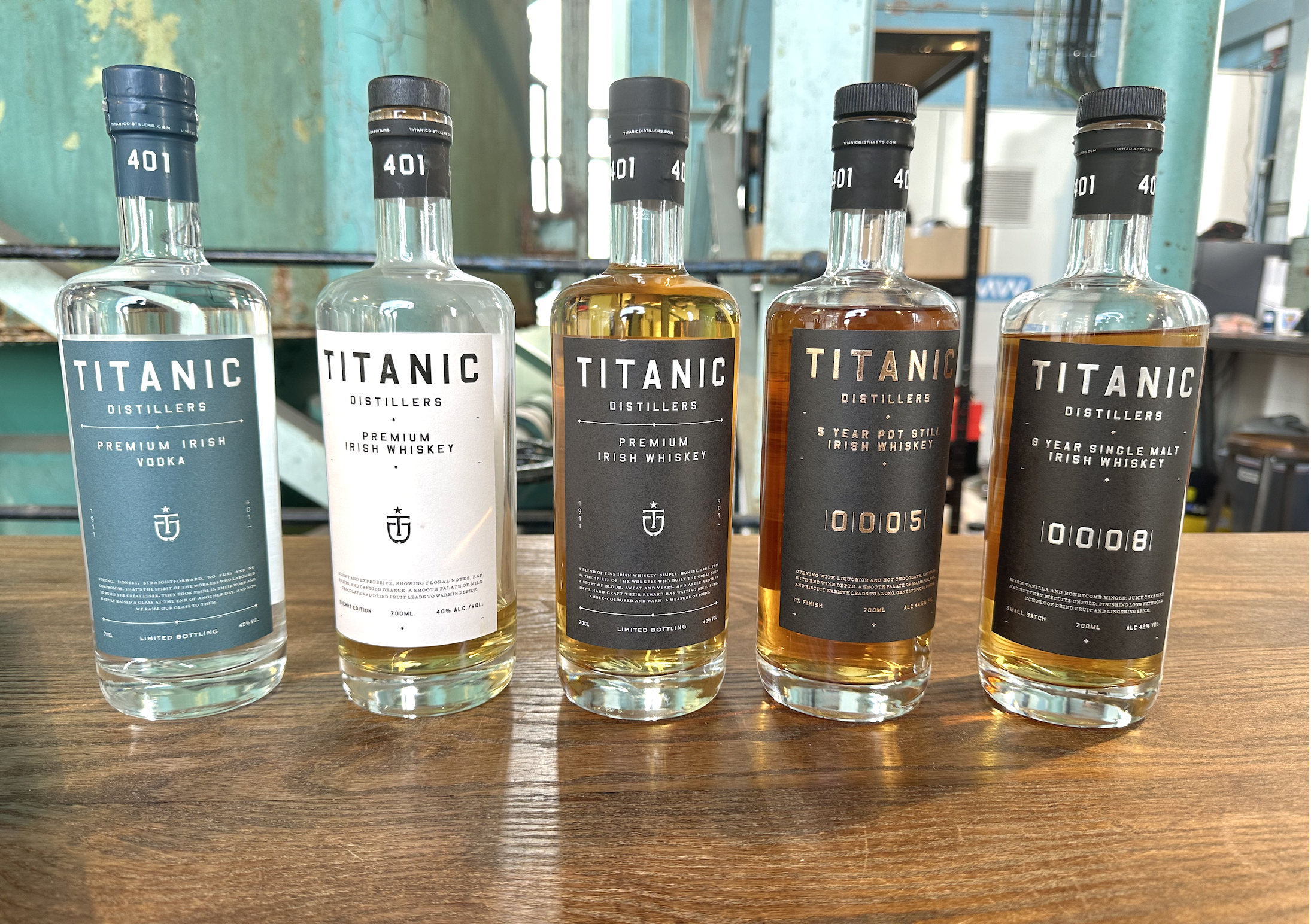
Titanic Distillers range of spirits
Titanic’s own Belfast whiskey is only now reaching legal whiskey age, so its mature releases necessarily come from elsewhere. An eight-year-old single malt released while I was there was comfortably the standout of the current selection, with considerably more weight and depth than the standard blend, while also underlining the peculiar halfway stage these new Belfast distilleries occupy: selling mature whiskey today while waiting to discover what their own mature whiskey will eventually become.
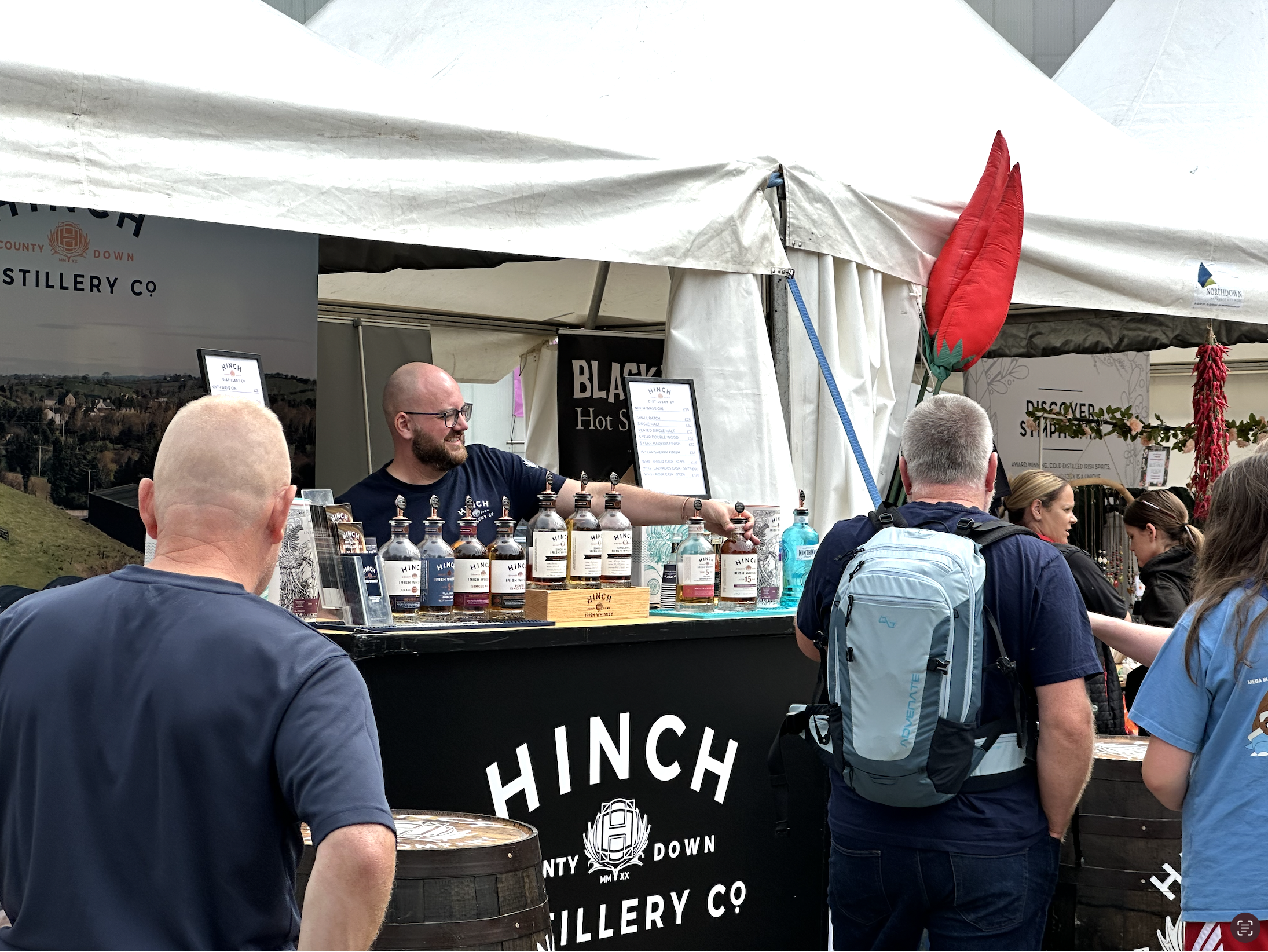
Outside the city, Northern Ireland is already further along that road. Shortcross began distilling at Rademon Estate in 2015 and has developed a strong following around its own mature releases, while Hinch has put out both unpeated and peated single malts from its County Down operation. Copeland in Donaghadee has also crossed the line from sourced whiskey into mature spirit mashed, distilled and aged at its own distillery.
Limavady remains far smaller and less widely known, but was one of my discoveries of the trip. Former Bushmills distiller Darryl McNally selects individual bourbon barrels of Irish single malt before finishing them in PX sherry, and the whiskey I tried was excellent, packed with dried fruit and spice while keeping plenty of malt underneath. Carnlough, another McNally project, pushes further into selection, blending and finishing rather than pretending that every credible whiskey brand needs a set of stills.
Gareth Irvine, founder of Copeland Distillery, has already lived through the transition Belfast’s newest producers are now making.
“Our sourced releases played an important role while our own spirit matured, but being able to bottle whiskey that we mashed, distilled and matured ourselves changes the conversation completely,” he told me.
Irvine is less doctrinaire about provenance than that might suggest. “Whiskey drinkers in general are probably more pragmatic than distillers sometimes give them credit for. Ultimately, the liquid has to be good. Consumers aren’t going to buy something simply because you distilled it yourself.”
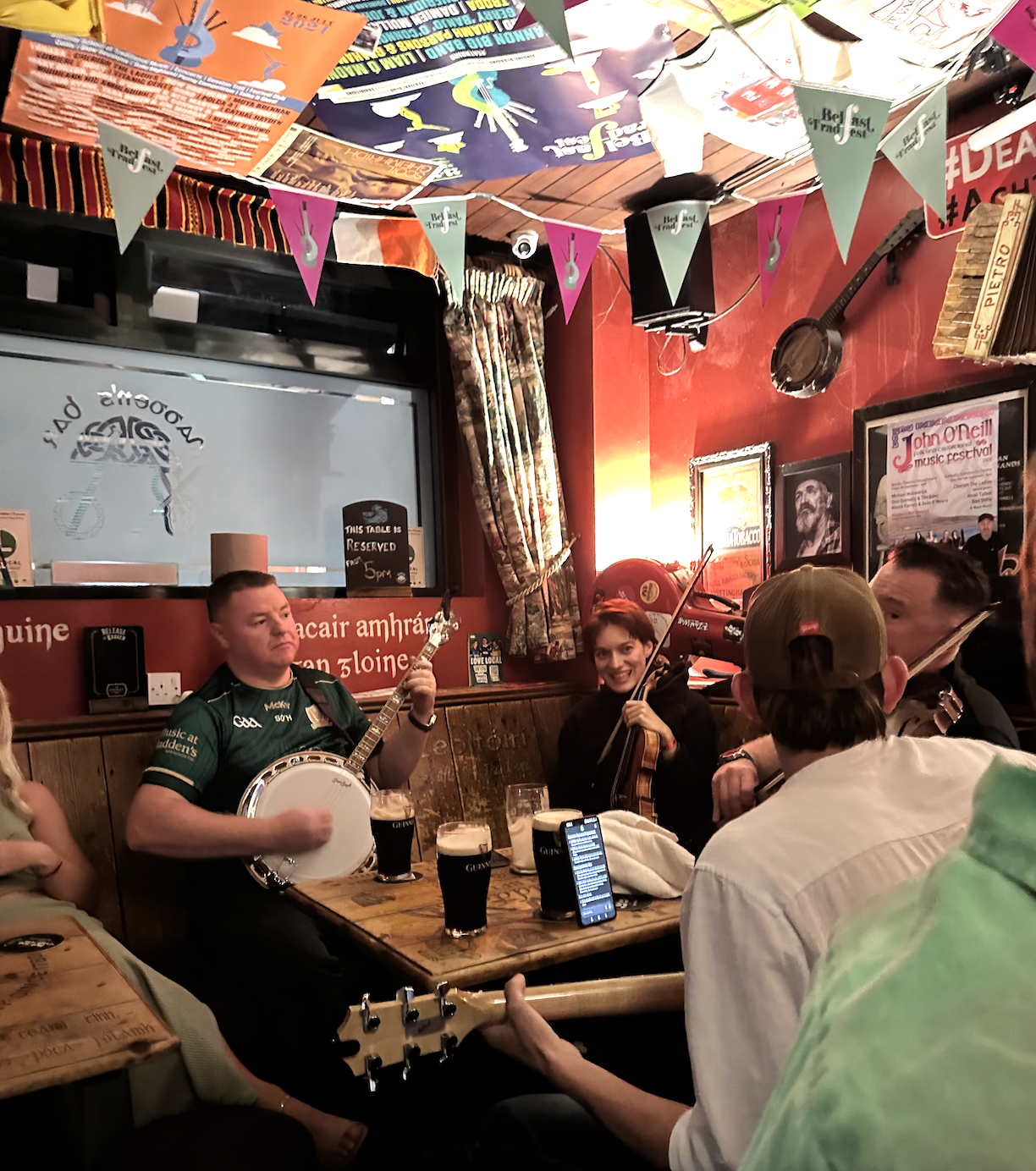
Guinness, whiskey and music at Maddens
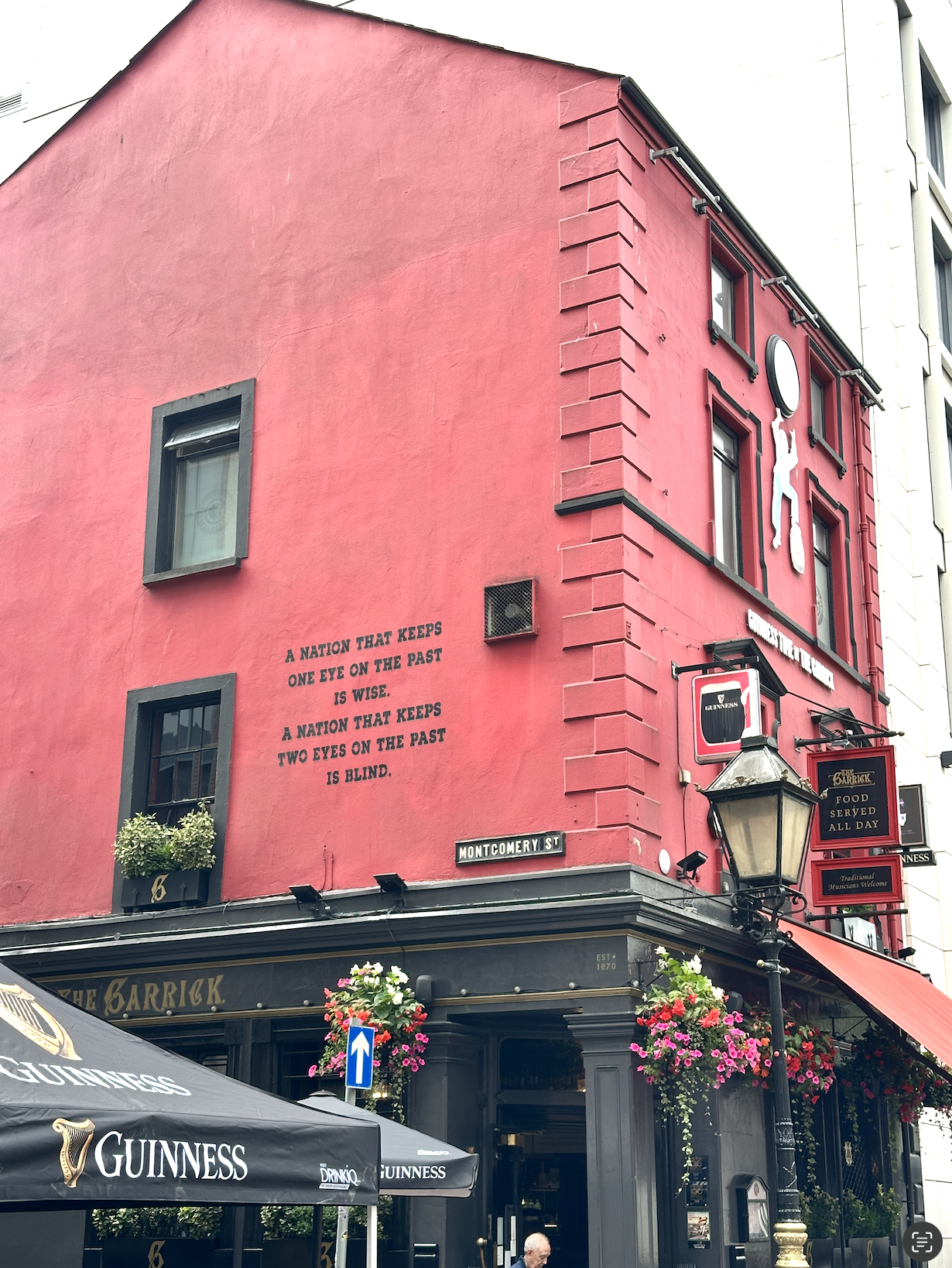
During Belfast Whiskey Week, we regularly ended up in Maddens, one of Belfast’s great whiskey pubs and the unofficial after-party venue for Whiskey Week, drinking through Copeland, Hinch, Shortcross and whatever else appeared on the table with Kane and an ever-changing cast of locals. It was packed cheek to jowl, a fiddle band squeezed into the corner while pints of Guinness travelled precariously over shoulders and people spilled into the street.
On one night a chap was physically thrown out, and the burly man who had done the throwing told me afterwards that he had only recently been released from prison for murder. Around us there was plenty of back-slapping and laughter, but also talk about old grudges, violence and parts of the city where wandering into the wrong place or speaking to the wrong person could still be a bad idea. Belfast’s whiskey scene does not come wrapped in the soft-focus calm of a Speyside distillery trail. There is still some grit around the edges, and the nights are all the livelier for it.
The scale of the wider Irish comeback is striking. From scores of distilleries at the industry’s historic peak, production had fallen to just two sites by the 1970s and was still only four operational distilleries in 2010; by 2024 the number was close to 50.
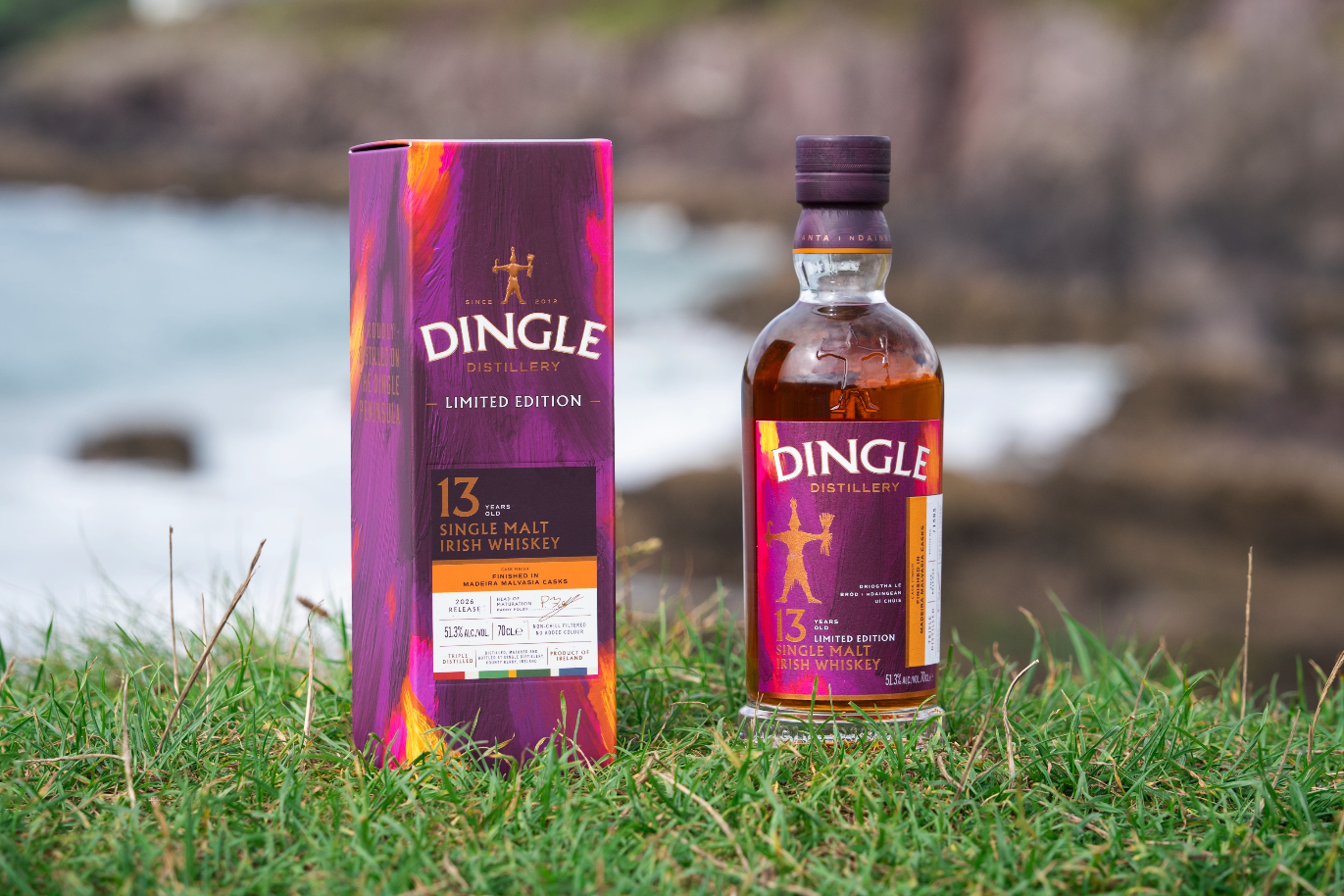
Dingle are among the oldest of the new generation of Irish distilleries having released a 13 year old
Dingle in County Kerry was early enough into that modern wave to have genuinely mature stock of its own, having begun production in 2012.
“Provenance has always been at the heart of Dingle,” says Niall O’Connor, senior marketing manager at Dingle Distillery. “Consumers are increasingly interested not just in what’s in the bottle, but where and how it was made, and being able to say our whiskey is distilled, matured and bottled in Dingle gives us a genuine point of difference.”
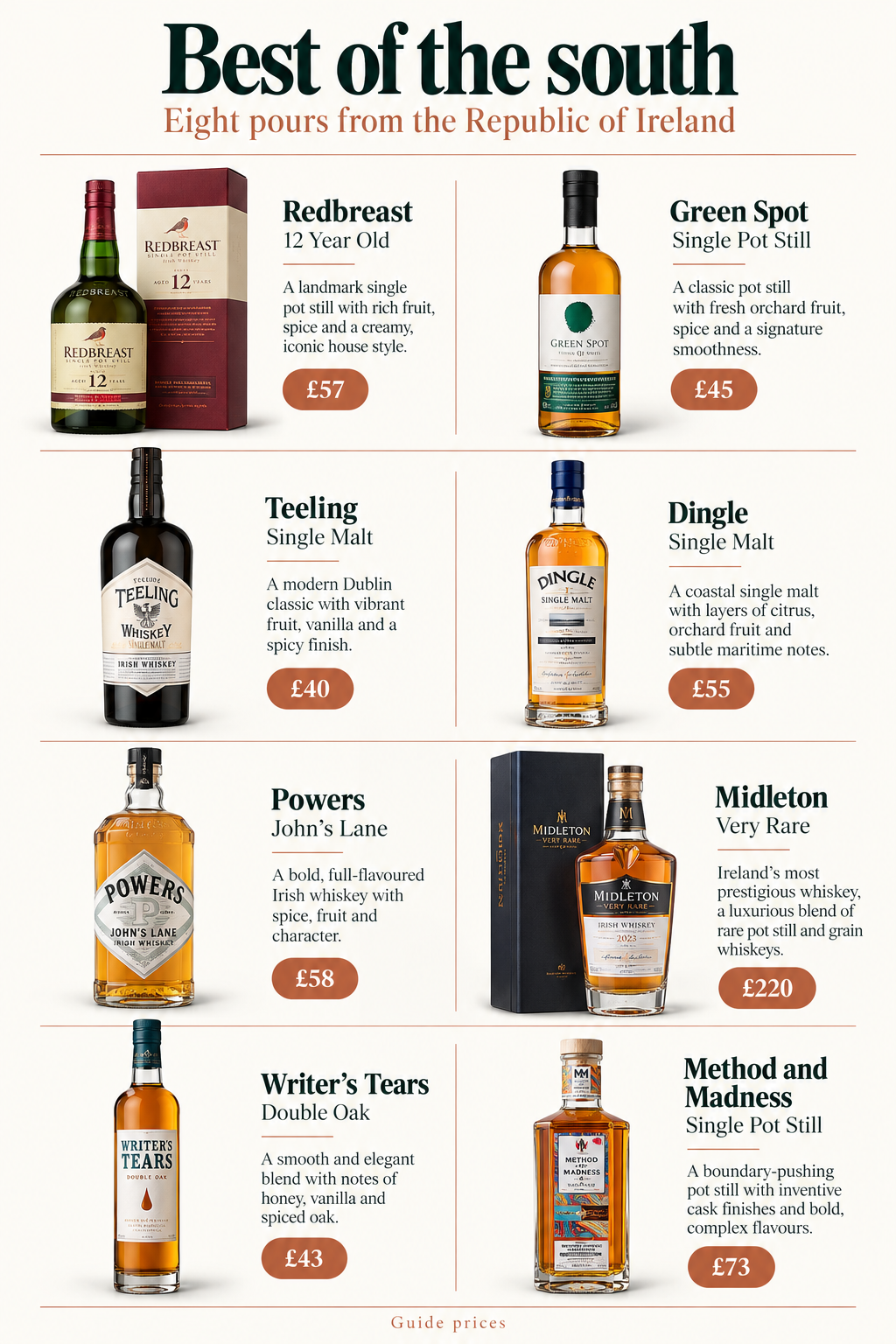
At the other end of the scale sits Irish Distillers, owned by Pernod Ricard and responsible at Midleton for Jameson, Redbreast, Powers, the Spot whiskeys and Midleton Very Rare. It sees the multiplication of competitors as a benefit rather than a dilution of the category.

“The growth in distilleries and brands is a positive reflection of the strength and attractiveness of Irish whiskey,” a spokesperson told Barley. “A vibrant category increases awareness encouraging more consumers to explore and engage with Irish whiskey.”
There is a reason those established names remain so dominant. Jameson is one of the world’s biggest-selling whiskey brands, Redbreast has become one of the most respected names in Irish whiskey and Midleton Very Rare sits firmly in collectable territory. Put the best of them beside most of the younger northern releases at the moment and the extra maturity, integration and consistency in the glass is obvious. The newer distilleries bring energy, experimentation and some excellent whiskey, but they are not starting on a level playing field against companies with decades of mature stock and blending experience.
Whether all of Ireland’s new distilleries can survive long enough to build the same depth is another question, and Copeland’s Irvine doubts they will.
“Probably not, and I think that’s simply the reality after the level of growth and investment we’ve seen across Irish whiskey,” he says. “Making great whiskey is only one part of building a successful distillery. You need patient capital, distribution, a clear identity and, ultimately, consumers who keep choosing your bottle.”
For Irvine and Copeland, those pressures began years before their own whiskey was mature. “We had to build the Copeland brand, establish routes to market, develop a team and learn what customers actually wanted, all while our own spirit was sitting in cask,” he says. “Distilling whiskey is the romantic part; building a sustainable business around it is much harder.”
Kane faces a related problem in Belfast because two city distilleries and a growing cluster around County Down do not automatically create a whiskey destination. He remains frustrated by the lack of support and coordination from tourism bodies, contrasting Northern Ireland with places such as Speyside where competing producers understand that persuading somebody to travel for one distillery usually benefits everyone around it.
“I don’t think the tourist boards really understand whiskey,” he says. “Whiskey tourism is a global thing.”
Whiskey Week remains relatively small and deliberately so, with Kane preferring a handful of people on a walking tour who can actually talk to the guide, and tastings where £10 can buy three drams. Its closing weekend nevertheless gave a glimpse of what Belfast looks like when an event takes over the whole city.
Whiskey Week finished on 1 August and the traditional music festival Fleadh Cheoil na hÉireann began the following morning. By then musicians were already filling pubs, markets, street corners and distilleries, and across the following eight days Belfast city centre recorded footfall of 1.65 million. For a few days the city felt less like somewhere hosting a festival than a city that had become one.
Belfast once shipped whiskey through its docks by the million gallons. Nearly a century later, the volumes are smaller, many of the businesses are young and not all of them will survive, but for the first time in generations whisky made in Belfast is being drunk again.