Inside the world’s oldest new bourbon release
The Eagles have landed
Buffalo Trace has just released Eagle Rare 30, the oldest age-stated bourbon in its history. At the first tasting in the world, Tom Pattinson sampled the full Eagle Rare flight side by side – from 10 years old through to 30
For much of the drinks industry, and whisky in particular, the story over the past two years has been a gloomy one. Distilleries are reducing production, warehouses are full, younger drinkers are drinking less and the overproduction of the Covid years is still hanging over the market. Which is why what is happening at Buffalo Trace feels so striking.
The Kentucky distillery, which already fills around 2,500 barrels a day, has invested more than $1.2bn (£900m) in expansion in recent years and still struggles to keep up with global demand. While other producers are cutting back, Buffalo Trace is building more warehouses, laying down more spirit and experimenting more aggressively than ever.
Its latest move may be its boldest yet. This month, Buffalo Trace will release Eagle Rare 30, the oldest age-stated bourbon in the distillery’s history and one of the oldest bourbons ever commercially released anywhere in the world. Bonhams will auction the first and second bottles ever produced between 24 April and 8 May, alongside a range of other rare Eagle Rare releases, experiences and private barrel tastings.
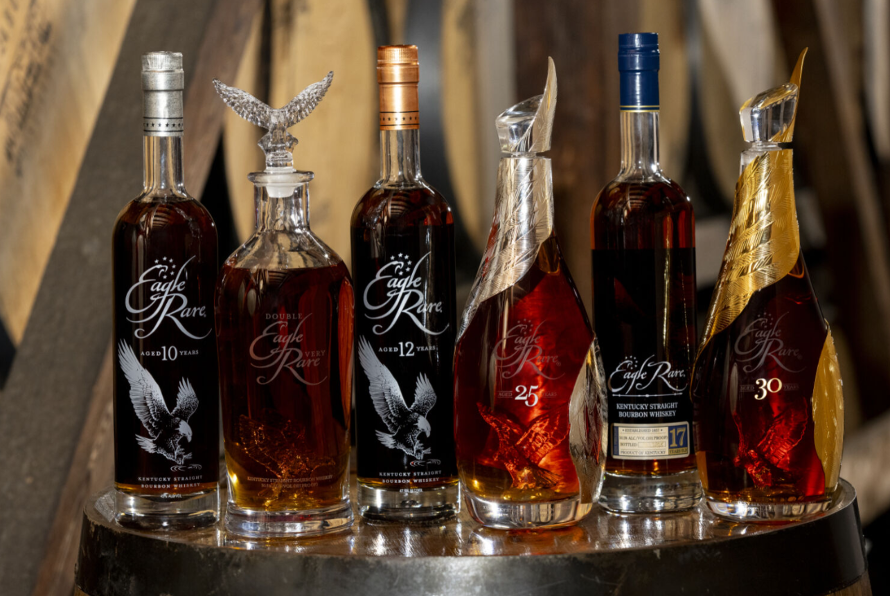
I was invited to taste the entire Eagle Rare line-up in a single sitting, becoming among the first in the world to try the full flight from Eagle Rare 10 through to the new Eagle Rare 30. It is not often you get the chance to taste a brand evolve in real time.
Buffalo Trace itself is arguably one of the best-value bourbons on the market. Softer and sweeter than Wild Turkey 101, richer than Jim Beam White Label and more characterful than Maker’s Mark, it is a bourbon that delivers caramel, vanilla, brown sugar, orange peel and soft spice at a price that rarely creeps much above £30 in the UK.
Unlike Scotch, most bourbons do not carry age statements. Once a bourbon is more than four years old, there is no legal need to state its age on the label. Buffalo Trace is usually bottled around eight years old, but when that same liquid reaches its tenth birthday it becomes something else entirely: Eagle Rare.
“Eagle Rare is the same mash bill and the same recipe of what Buffalo Trace is,” says Liam Sparks, head of prestige at Sazerac. “That is standard Eagle Rare 10. A couple of years older, slightly higher proof. I think it’s arguably one of the best value whiskies in the world for the price point.”
He is probably right. Eagle Rare 10 remains one of the great bargains in whisky. At under £40, it feels almost absurdly underpriced when compared with similarly aged Scotch. It has the sweetness of Buffalo Trace, but more depth. There is more vanilla, more oak and more rye spice, with a longer finish and a richer texture.
“It’s Buffalo Trace but a big hug,” Sparks tells me. Then came Eagle Rare 12, released for the first time in 2025. That extra two years gives it noticeably more richness. The vanilla deepens, the oak pushes further forward and there is a faint tobacco note emerging.
By the time you reach Eagle Rare 17, which is released as part of the annual Buffalo Trace Antique Collection, the bourbon begins to move into cigar box territory. The oak becomes more assertive, there is dark chocolate and leather on the nose and the finish becomes longer and drier.
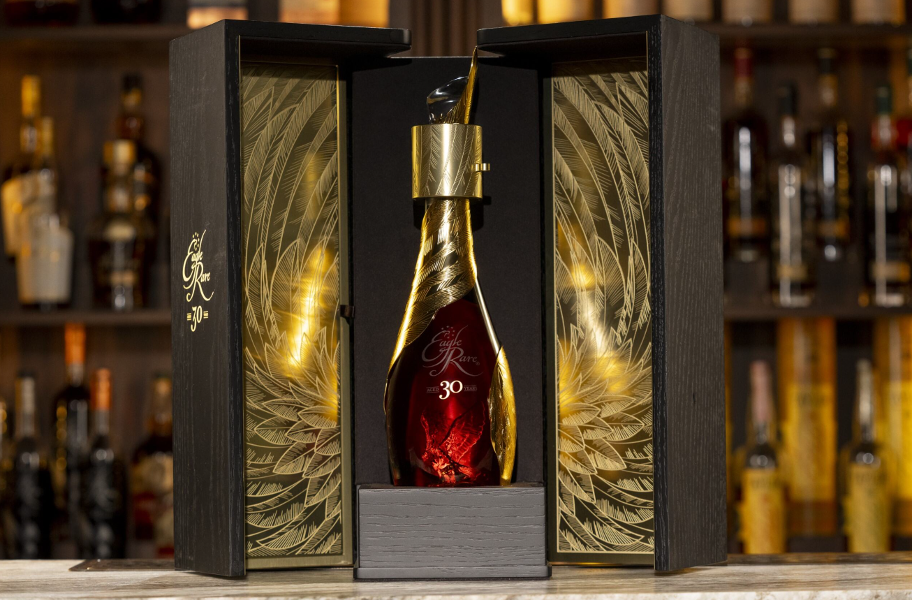
One of the few bottles of Eagle Rare 30 and one of the oldest new bourbons in the world
That dryness matters because bourbon ages very differently to Scotch. Kentucky’s hot summers and dramatic seasonal changes mean spirit matures faster than it does in Scotland or Ireland. Oak gets into the liquid quicker. Evaporation is higher. At Buffalo Trace, around half the liquid in a barrel can be lost after ten years.
“Even after Eagle Rare 10, at ten years, you’ve lost half your liquid in the barrel,” says Sparks. “So we start off with 200 litres and after ten years you’re down to 100 litres.”
That heat can be a blessing early on. It is what gives bourbon its sweetness, its richness and its intensity. But beyond 15 or 20 years it becomes a problem.
“Twenty years ago, if you’d released a 30-year-old bourbon, what happens with age and the climate is bourbon becomes very dry, lots of astringency,” Sparks says. “You could have an old bourbon over time, but it would be over-oaked, unpleasant, and therefore wouldn’t do anything to the category.”
That problem is exactly what Buffalo Trace has spent the past two decades trying to solve. The distillery first began serious experimentation in 2007 when master distiller Harlen Wheatley introduced a microstill that allowed small-scale trials. Then came Warehouse X in 2013, an experimental warehouse designed to study the effects of airflow, humidity, temperature and light on ageing.
In 2019 Buffalo Trace opened Warehouse P, a fully temperature-controlled warehouse designed specifically to slow maturation and see whether bourbon could age in the same way as whisky from cooler climates.
“It’s a temperature-controlled, closed ageing warehouse,” Sparks explains. “Not just temperature, but we can control airflow, humidity, everything that goes with it.”
Warehouse P has changed what is possible in bourbon. The first expression to emerge from it was Eagle Rare 25, released in 2023. It is a dramatic leap from the 20-year-old Double Eagle Very Rare. Double Eagle Very Rare, first released in 2019, is an impressive bourbon. It has huge depth, rich chocolate notes and considerable spice, but the dryness comes through quickly. You can feel the oak tightening around the liquid.
With Eagle Rare 25, however, the oak softens. The first thing that struck me was how much fresher it felt. There is still oak, but it is less dominant. The spice is gentler, there is more dried fruit and more sweetness, and the whole bourbon feels more balanced.
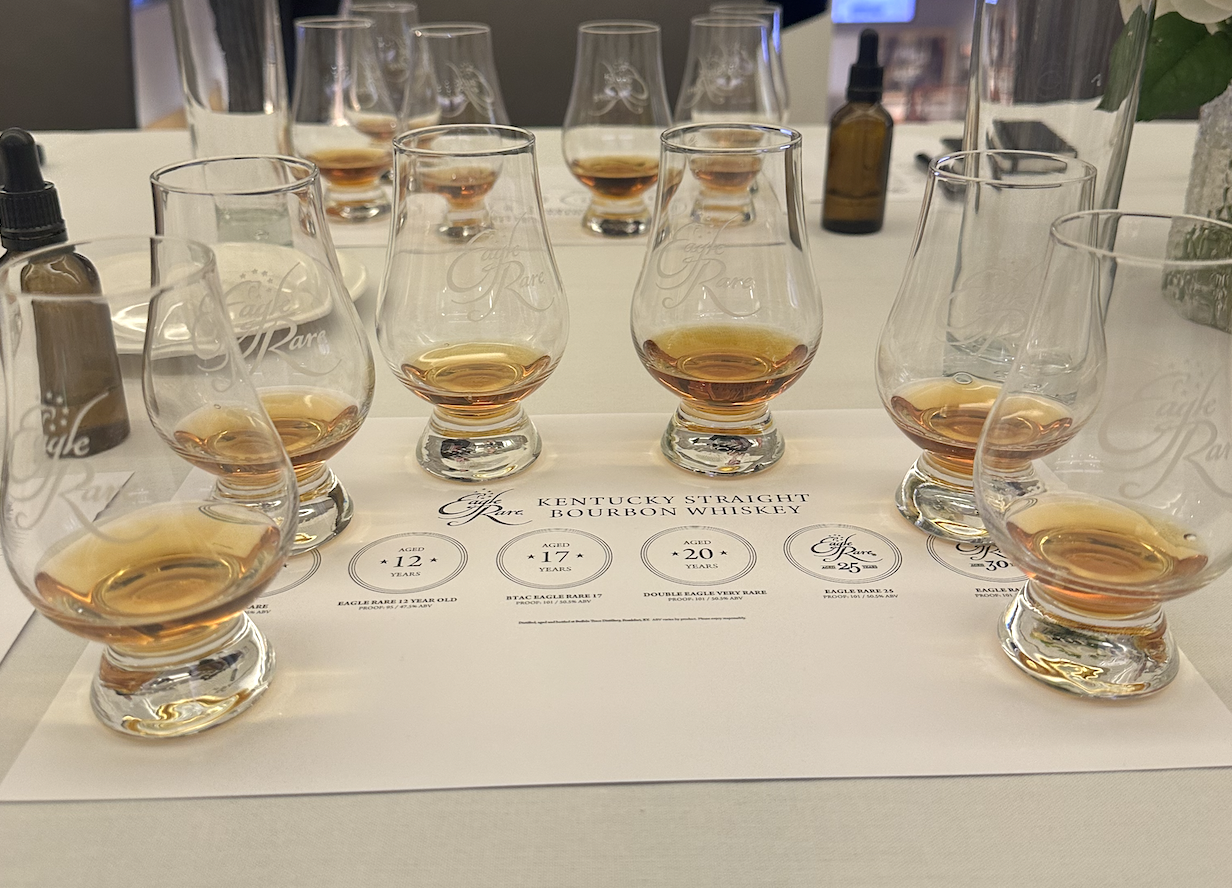
The full flight of Eagle Rare: 10, 12, BTAC 17, Double Eagle Very Rare 20, 25 and 30
“It’s a game-changer,” Sparks says. “The whole idea with this is to say look, age is one thing, but we’re trying to get a liquid out that we believe is moving further in the right direction.”
Then came Eagle Rare 30. I expected something aggressive, dry and overworked. Instead, it was the opposite. The oak is still there, but it no longer dominates. There is vanilla, soft chocolate, dried fruit and tobacco, but with less spice than the 20-year-old and a silkier texture than the 25. It does not taste like a whisky that has been left in a barrel for too long. It tastes controlled.
“It’s about removing what that astringency would do if we aged in the same way in a Kentucky warehouse,” Sparks says. “This is about pushing those boundaries.”
Warehouse P is not simply about making older bourbon. It is about making older bourbon that is actually enjoyable to drink and has become one of the most ambitious experiments in American whiskey. Master distiller Harlen Wheatley says Eagle Rare 25 and 30 are not “just about time, they’re about what time reveals”.
That is exactly what makes this range so fascinating. You are not simply tasting older versions of the same bourbon. You are tasting the limits of Kentucky ageing, then tasting Buffalo Trace trying to break through those limits. And there is a reason these bottles are so expensive. At ten years old, around half the liquid is already gone. By 20, 25 or 30 years, very few barrels survive. Buffalo Trace will not reveal exactly how many bottles of Eagle Rare 30 exist, but there are thought to be fewer than 200 bottles of the 25 year old. For the 30, it is likely to be just double figures. The UK allocation is tiny.
Bonhams’ auction will include the first bottle ever produced of Eagle Rare 30, estimated at £7,500 to £10,000, and a complete Eagle Rare collection including Eagle Rare 10, 12, 17, Double Eagle Very Rare, Eagle Rare 25 and the second bottle of Eagle Rare 30, estimated at £20,000 to £30,000.
There will inevitably be people who dismiss this as marketing theatre. Others will argue bourbon should never be aged this long. They have a point. Plenty of very old bourbon is simply too woody, too dry and too dominated by oak. But Eagle Rare 30 is different. “We haven’t made what we believe to be our best whiskey,” Sparks says. “So we will push those boundaries to experiment and move forward.”
That might sound like salesmanship, but after tasting the entire Eagle Rare flight in one sitting, from ten years old to 30, I think Buffalo Trace may actually believe it. And they may be right.
Eagle Rare 30-Year-Old Bourbon Takes Flight: The Ultimate Eagle Rare Release will be available from Bonhams.com the auction runs between 24 April – 8 May 2026.